What do AI automation agencies do? (UK SME explainer)
Plain-English explainer for UK SMEs: what an AI automation agency builds, how engagements usually run, workflow vs chatbot vs internal tools, and ownership questions that matter.
If you have sat through one more “AI transformation” call and still cannot say what you would actually buy, you are not alone. The label is fuzzy. Some firms mean a chatbot on a website. Others mean a six-month strategy deck. A few mean something useful: a working system that removes busywork from your week.
This piece is the plain-English version. What an AI automation agency delivers, how a typical engagement runs, and how workflow builds differ from chatbots or custom internal tools. It is written for UK founders and ops leads who want scope clarity before they shop.
If you already know you need a partner and want buyer questions and red flags, that is a different guide — how to choose. This one is about the work itself.
What an AI automation agency actually delivers
Strip the buzzwords and the job is operational. An AI automation agency maps a process in your business, wires software (and often AI) into that process, and leaves you with something that runs inside your stack — with visibility and a way to stop it.
In practice, that usually means some mix of:
- Process mapping — watching how work really moves today: triggers, handoffs, exceptions, the bits that always break.
- Workflow design — deciding what a machine can do safely, what needs a human, and what “done” looks like.
- Integrations — connecting the tools you already use (CRM, inbox, calendar, forms, spreadsheets, internal APIs).
- Build and test — rules, prompts, agents, or scripts run against real cases, not only a happy-path demo.
- Monitoring and handover — logs, a dashboard, ownership of accounts and credentials, documentation a non-specialist can follow.
- Change support — optional ongoing help when the process or tools shift.
What it is not: a general “AI strategy” retainer with no weekly deliverable. Not a model-name parade before anyone has watched your team work. Not a black-box subscription you rent forever with no export path and no ownership of the workflow logic.
On our side at Kreatrs, the client work shows up as three steps we state on our automation page: find the busywork, build the agent, hand over the keys. The agent sits in your systems. You get the dashboard, the logs, and the off switch. We stay available when you want the behaviour changed.
Typical engagement shapes (discovery → build → handoff)
Every serious build follows a similar arc, even when the tools differ. The names change. The sequence does not.
1. Discovery. Someone sits with your team and maps where hours actually go. Inbox triage. Follow-up calls. Copy-paste between tools. The output should be a shared picture of one process: trigger, steps, exceptions, and what success looks like. If discovery never leaves a slide deck, you do not have a discovery yet.
2. Build. The agency wires the automation to your stack and runs it against real cases until it behaves the way you would. Edge cases get documented. Failure paths get designed — not ignored. Parallel running with the old manual process for a stretch is common sense, not optional theatre.
3. Handoff. The system runs in your environment, not theirs. You control access. You can see what it did. You can turn it off. Documentation and credentials travel with you. Support after go-live is a conversation you have before go-live, not a surprise invoice.
That shape matches how we describe our own work: find the busywork, build the agent, hand over the keys. Timelines are scope-dependent. Our public FAQ gives examples for websites and complex apps (roughly weeks to months depending on complexity) and says detailed timelines come from the initial consultation — we do not invent automation-specific SLAs here.
Pricing on the live site is quote-based: fixed-price or hourly depending on scope. No public bands. If someone quotes a magic number before mapping your workflow, treat that number as marketing, not engineering.
Workflow vs chatbot-only vs custom internal tools
Buyers often mix three different things. They are not the same purchase.
Workflow automation is multi-step process plumbing. Something happens (form fill, email, missed call). The system triages, updates a CRM, books a slot, chases a reply, or escalates to a person. AI may read unstructured input; rules may route the rest. The point is the process, not a chat window.
Chatbot-only is a conversation surface — often on a website or in WhatsApp — that answers FAQs or collects details. Useful for simple enquiry deflection. Not the same as end-to-end busywork removal. A bot that chats but never updates your systems is a front door with no corridor behind it.
Custom internal tools are apps or admin panels built for your team: dashboards, approval screens, internal search over your documents, ops consoles. They may include AI, but the deliverable is software you operate, not only a glue workflow between SaaS products.
Many real projects blend these. A voice or chat front end might feed a workflow that updates your CRM and books a meeting. An internal tool might sit on top of automated pipelines. What matters is naming what you are buying so scope does not quietly expand from “answer the FAQ” into “rebuild operations” without anyone agreeing.
On the Kreatrs automation page we talk about AI agents, voice, and workflow automation for clients — plus custom internal tools in the meta framing. We also run our own products in the same discipline. That keeps us honest about edge cases. It does not mean a client engagement starts with a product upsell. Agency builds and product GTM are different conversations.
Tools and ownership questions UK buyers should ask
You do not need a forty-point RFP to understand the scope of work. You do need clear answers on tools and ownership before anyone writes code.
Tools — and why those tools. A serious agency can say why a given automation platform or language model fits your case, where a plain rule is safer than AI, and what they would refuse to use for your job. Silence on limitations is louder than a feature list. Our studio stack for broader digital work includes React, Next.js, Node.js, Python, TypeScript and common CMS platforms; for automation, the right glue depends on your systems and risk appetite, not a fashion list.
Ownership when you part ways. Who owns the prompts, the data, the accounts, and the workflow logic? Where does personal data sit? Can you export and revoke access cleanly? If the relationship ends tomorrow, do you still have a runnable system — or a dependency you cannot leave?
UK data reality (not legal advice). Ask about processors and sub-processors, whether a Data Processing Agreement is on the table before go-live, and how you would delete or export data later. Regulated sectors need their own counsel. What you want from an agency is comfort talking about GDPR-shaped constraints without hand-waving — and a handover that includes documentation, credentials you control, and a runbook a non-genius can follow.
Failure handling. Every useful system fails sometimes. You want confidence thresholds, human review queues, escalation paths, and audit logs — not “it never fails.” If they cannot describe what happens when the AI is wrong, they have not shipped enough real work.
Success before build. Hours saved, response time, error rate, conversion on one step — pick something countable and agree it early. Soft deliverables hide soft outcomes.
When an agency is the wrong fit
An agency build is not always the right next step. Be honest about that early — it saves everyone money.
You probably do not need a custom agency engagement if:
- Off-the-shelf tools already cover the job (meeting notes, light drafting, simple form-to-sheet glue) and nobody has tried them properly.
- Nobody on your side will own the process after go-live. Automation without an internal owner becomes shelfware.
- The “problem” is still a vibe (“we want AI”) rather than a written workflow with a trigger, steps, and a definition of done.
- You need legal or clinical advice dressed up as an automation project. That is counsel first, build second.
- You want a strategy deck more than a working system. Plenty of firms sell that. Call it consulting, not automation.
Commission a build when the process is proprietary, multi-step, tied into your systems, and worth getting the edge cases right. Most UK SMEs do not need a transformation programme. They need one system that works on Monday morning.
How Kreatrs approaches automation builds
We are a UK digital design and AI automation studio. On automation we say it plainly: we build AI agents, voice, and workflow automation for clients — and we run our own products in the same discipline, because shipping for ourselves keeps us honest about edge cases.
The working shape is deliberately small:
- Find the busywork — we sit with your team and map where hours actually go.
- Build the agent — wire it to your stack, run it against real cases until it behaves the way you would.
- Hand over the keys — it runs in your systems. You get the dashboard, the logs, and the off switch, with us on call when you want it changed.
You can skim shipped work on our works hub, and the studio framing on About. What we will not do here is invent testimonials, traffic figures, or “% time saved” stories. If a result is not approved and dated, it does not belong in an explainer.
Next step
If the messy process is already clear in your head, write it down: trigger, steps, done, exceptions. Bring that one-pager. We would rather argue about edge cases than pretend a vague “AI programme” is a plan.
See how we run automation builds on kreatrs.com/automation, or get in touch for a quote or a demo conversation. Start narrow. Ship something that runs. Then decide what deserves a second build.
Kreatrs Editorial
Kreatrs Media Team
Read more articles by Kreatrs Editorial on Kreatrs.
Related Blogs
CRM Built Around Your Workflow: Meet Kreatrs Flow
Sep 20, 2026
Kreatrs Flow is a CRM built around your workflow—not a rigid template. Custom fields, pipeline views, and a ready handover. See the product page or live demo.
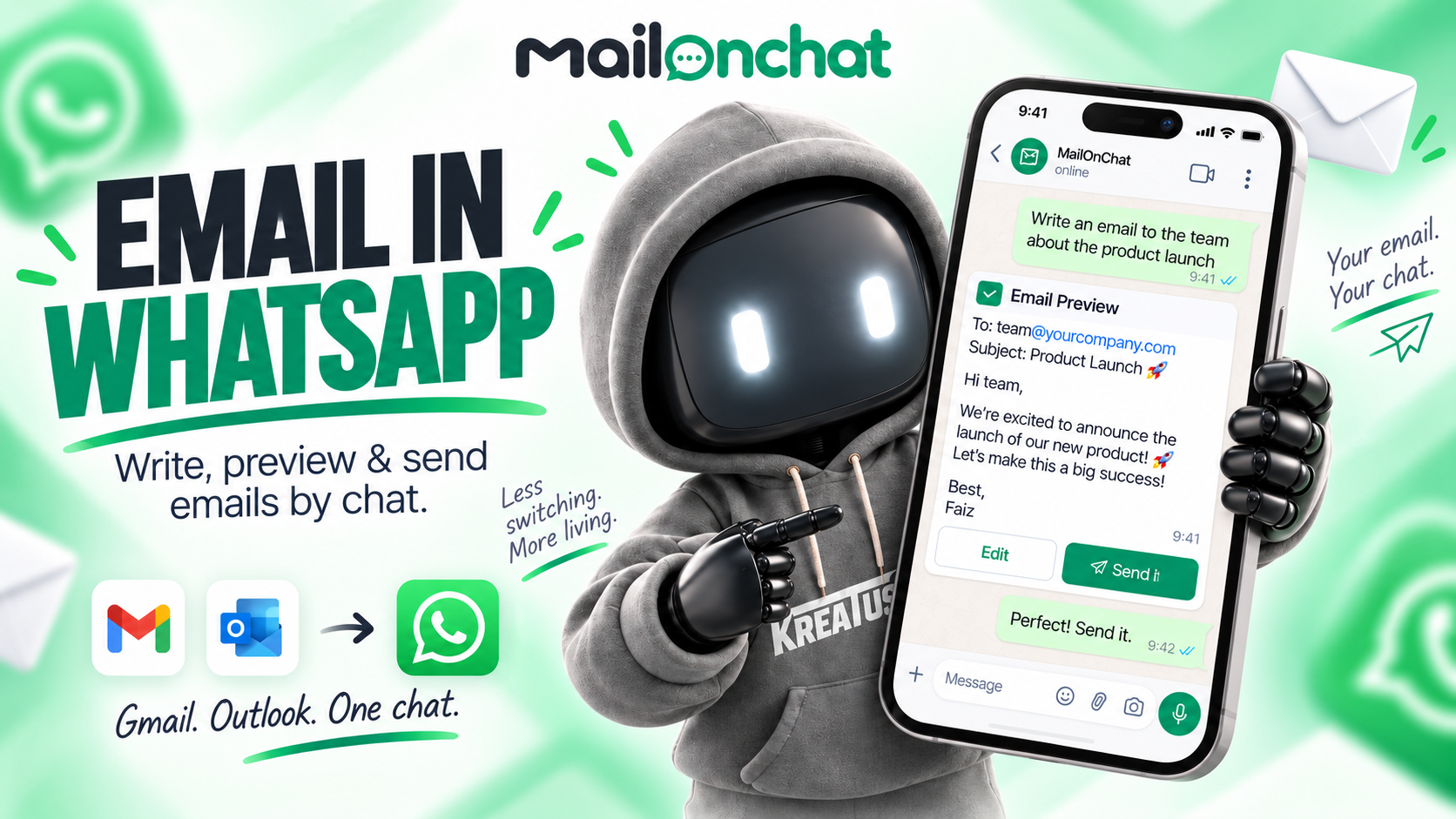
Email in WhatsApp: Manage Gmail & Outlook from Chat
Sep 17, 2026
MailOnChat puts Gmail and Outlook in WhatsApp. Draft, review, send, and get a daily inbox summary—no extra app. Outlook live; Gmail invite-only for now.

Navigating Content Hubs for Enhanced SEO
Jun 27, 2026
Discover how content hubs can boost your SEO strategy by organizing related content into a cohesive structure that improves user experience and search visibility.